7 Deadly Sins Test: A Pokémon Trainer Challenge
Read your result, pick a habit to play with, and build a fan-made trainer challenge around the Pokémon you roll.
A 7 deadly sins test asks which everyday habits show up most in your answers. Do you dig in when someone corrects you? Keep scrolling after the fun wears off? Put off a task even when you have the time and energy to start? The result gives you seven scores for patterns like these. Think of the highest bar as a prompt for a story, not a verdict about you.
If you came to take the 7 deadly sins test, the quick version has 21 statements. The full version has 70 and covers more situations. Both look at habits rather than Pokémon knowledge or religious beliefs. You don’t need a result to play along here: pick any row below if you’d rather skip the quiz.
What does a 7 deadly sins quiz tell you?
Seven Sides gives you separate scores for pride, envy, wrath, sloth, greed, gluttony, and lust. Each score reflects your answers to a group of statements. A 75 for pride doesn’t mean you’re more prideful than 75 percent of people. The scores don’t have to add up to 100, and a high score in one category doesn’t push the others down.
Start with the situations behind the result. In the sample question below, the key detail is defending your view before considering someone else’s point. Standing by a well-considered opinion is a different thing. If a question doesn’t apply to you, the quiz gives you a separate option for that; use it rather than imagining how you might behave.
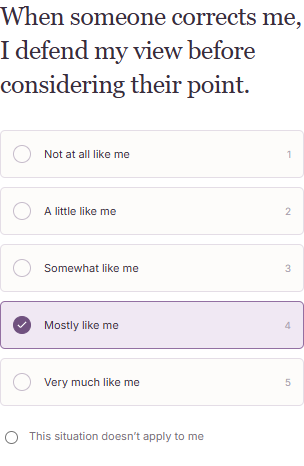
Seven Sides example question. The wording tells you more about the habit being asked about than the category name alone.
If two bars are close, either can be the starting point for this challenge. If nothing stands out, choose the scenario you’d most enjoy writing or playing. The quiz is for entertainment. It doesn’t match you to a species, and the challenge below is an independent fan activity.
Seven results, seven trainer challenges
The traditional names can sound severe. For a game, it helps to translate each one into a decision a fictional trainer has to make. The last column gives you one rule you can try, even if your random roll looks nothing like the character you pictured.
| Result | Everyday pattern in this quiz | Fan-made trainer rule |
|---|---|---|
| Pride | Defending your first answer before listening to a correction | Keep your first roll, but let a friend point out one weakness and choose how you’ll cover it. |
| Envy | Treating someone else’s win as evidence that you’re falling behind | Build around an option you like before looking at anyone else’s team. Compare game plans afterward. |
| Wrath | Firing back while you’re angry or replaying the conflict later | After a setback, pause and name two possible moves before picking one. |
| Sloth | Delaying an uncomfortable task despite having the time and energy | Take the first eligible roll and write one useful role for it before changing filters. |
| Greed | Accumulating more after the original need has been met | Stop when every role you planned has a pick. Leave extra rolls off the roster. |
| Gluttony | Continuing an enjoyable activity after your intended stopping point | Decide on a roll limit before you start; use the final eligible draw if you reach it. |
| Lust | Letting attraction hurry a decision you wanted to take slowly | Set aside the Pokémon whose design catches your eye. Read the other options before locking it in. |
That last rule uses visual appeal as a game metaphor. The quiz’s actual questions are about how attraction affects the pace of choices in real life. Likewise, the gluttony example is about knowing when you meant to stop, and the sloth example assumes you have the resources to start. Rest and downtime don’t call for a penalty.
Let the generator choose the cast
Open the Random Pokémon Generator and set one or two filters, such as a generation and a type. If you’re doing this with friends, agree on the same pool before anyone rolls. For a writing prompt, a broad pool usually gives you more room to be surprised. If you intend to play an actual battle, decide the game or format first and check whether the picks are legal in it.
- Choose the rule before you roll. Start with one result or one row from the table. Write down the limit or condition so you know when you’re done.
- Decide how many roles you need. For a story, try a lead, a companion, and a rival’s pick. For a battle draft, define roles you can check in the format you’re playing. You don’t need seven Pokémon just because there are seven quiz categories.
- Give each draw a job. Read its type and stats if those matter to the challenge. For a story, give it a scene. A surprise pick is much easier to use when you can say what you want it to do.
- Share the rule with the roster. “Three rolls, then I had to choose” tells a better story than a screenshot alone. Keep the quiz result to yourself if you’d rather talk about the game.
Avoid filtering for a supposed “Pride Pokémon” or “Wrath type.” Those aren’t properties the generator measures. The constraint belongs to the trainer. The Pokémon roll gives that trainer something unexpected to work with.
A worked example: one roll, one revision
Suppose Pride and Envy are the two tallest bars on your 7 deadly sins test result. You could design a trainer who hates changing their mind when someone’s watching. Pick Pride for the main rule: the trainer must keep the first draw. Use Envy for the scene: their friend draws a Pokémon they immediately wish they had.
Now give the trainer a decision with a visible outcome. Keep the first partner and ask the friend to name one role the team still lacks. The trainer can fill that role with another draw or adjust the plan to suit the partner they already have. If the friend likes the first plan, ask what would make them reconsider it. Either way, you have a better scene than “this trainer is proud,” because the reader gets to watch someone respond to feedback.
You can also try this as a two-player draft. Give both players the same filter settings and a three-draw limit. One player commits to their first eligible draw. The other compares all three before choosing. At the end, trade notes on what each rule made easier or harder. There’s no need to compare real-life scores or declare that one way of playing is better.
Quick questions before you play
Do I need the full version? The quick 7 deadly sins quiz gives you a seven-score profile with fewer questions. Try the full version if you’re curious about more situations. Both can supply a prompt for the same challenge.
What if my result changes later? Keep the team you made. Your answers may reflect a different stretch of life or bring different examples to mind. A new result can inspire a second draft without invalidating the first.
Can I play with no quiz result at all? Pick a rule at random or ask a friend to choose. The best rule is one you can describe in a sentence and follow even when the first roll surprises you.
Related resources
- Seven Sides project on GitHub — example questions, scoring notes, and a guide to reading all seven results.