Chainle Game: Rules, Word Bridges, and Practice Tips
A random team gives you a question: what can you do with the options in front of you? Chainle offers a smaller puzzle with a similar appeal. You get a few words, and your job is to find the connection you did not notice immediately.
Chainle is a word connection game in which you enter one English word related to every clue. A session contains five rounds. You have one valid guess per round, and stronger connections earn more points.
If you came looking for the rules, a useful strategy, or a way to keep playing after the daily puzzle, start here. You do not need Pokémon knowledge—or an unusually large vocabulary—to understand the task.
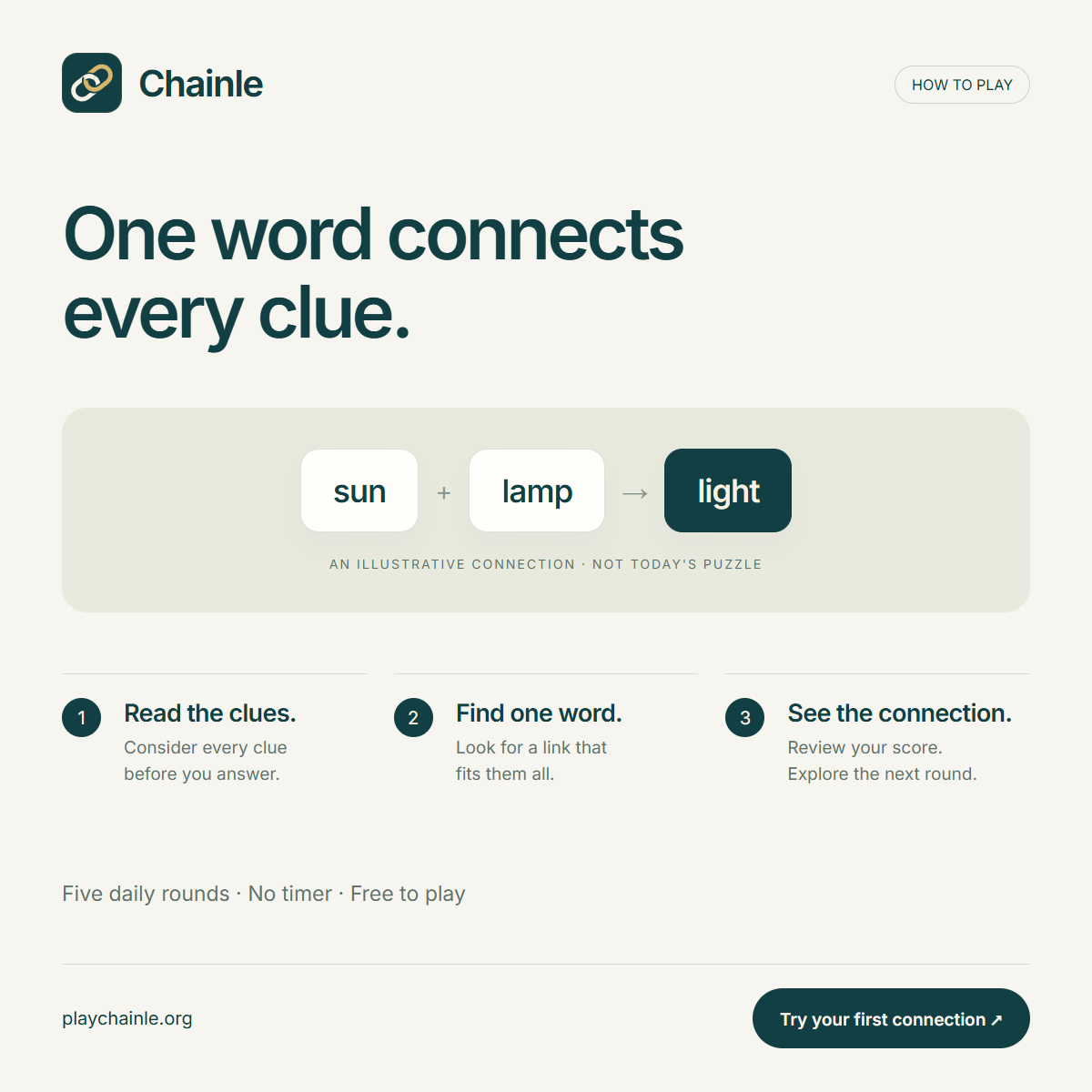
Image: Chainle. This is a teaching example, not today’s puzzle solution.
What is Chainle, and where do you play?
You can play Chainle free in your browser, without an account or app installation. The site offers a daily puzzle, unlimited practice, and an archive of available earlier puzzles. This guide describes the rules on that site.
The Chainle game is about associations in meaning. You are not unscrambling letters, completing a spelling grid, or changing one letter to make a new word. You are looking for a single answer that belongs alongside all the clues.
That makes it a word association game with an interesting constraint: a word that fits one clue brilliantly can still be a poor choice for the whole round.
There is also no timer. You can make a short list in your head, rethink an interpretation, and commit when you have a reason for every connection.
How a Chainle game works
Every session follows the same sequence:
| Round | Clues shown | What you need to do |
|---|---|---|
| 1–3 | Two words in each round | Find one word connected to both |
| 4 | Three words | Find one word connected to all three |
| 5 | One word | Find a close connection in meaning |
Type your answer, then choose Connect or press Enter. Once a playable word is accepted, Chainle reveals the result. Review it before moving to the next round.
Each round is worth up to 1,000 points, so a complete Chainle game has a maximum of 5,000. The reference connection is a useful benchmark, not necessarily the only word that can earn full points.
The distinction between an invalid entry and a weak answer matters. A phrase, an unsupported word, or a repeated clue can be rejected without using your turn. An accepted word that receives a low score does use the turn. Keep alternative guesses in your head rather than submitting them experimentally during the daily puzzle.
Try a word bridge before playing
Imagine the clues candle and crayon.
“Flame” fits candle. “Drawing” fits crayon. Neither explains the pair particularly well. Wax is a stronger human connection because it is a material associated with both objects.
This is the basic move in a word connection game: stop asking what follows one clue and ask what relationship reaches both.
Now try bird and airplane. You could connect them through flight, a shared activity, rather than a shared material. For recipe and map, consider guide: each can help someone reach an intended result.
These are practice illustrations, not verified Chainle puzzle answers or guaranteed scores. Their purpose is to show that the connecting relationship can change:
- Material: What are both objects made from?
- Function: What do both things help someone do?
- Action: What can both things do?
- Category: What broader idea includes both?
- Meaning: Does a familiar word have another relevant sense?
A word association game becomes easier to reason about when you name the relationship. You can then explain your choice instead of relying only on a feeling that the words belong together.
A useful habit for players who enjoy random challenges
If you use Random Pokémon Generator, you already encounter a distinction between choosing the conditions and responding to the result. Selecting a generation, region, or type narrows the possibilities; the generated selection gives you something concrete to work with.
Apply that idea to your thinking in Chainle. You cannot choose the daily clues, but you can choose how to inspect them. Give yourself a temporary “filter”: look only for shared functions, then try materials, then try categories.
This is a thinking exercise, not a built-in Chainle feature. It helps prevent one familiar association from dominating every candidate you consider.
You can also make a separate warm-up with the Random Pokémon Generator: generate a small selection, choose two results, and describe one shared trait in ordinary English. Try a broad description such as habitat, shape, movement, or appearance rather than naming a specific character.
Keep that activity separate from the actual word puzzle. Chainle is not a Pokémon guessing game, and its playable vocabulary should not be treated as a list of character names, moves, or abilities. The transferable habit is explaining a shared trait—not submitting franchise trivia as an answer.
Why your Chainle score can surprise you
Chainle scores the relationship between your answer and each clue. A convincing explanation in your head does not automatically produce a high score: the game has to recognize that relationship in its scoring data.
In a two-clue round, a weak connection on one side can pull down the whole result. If the scoring system finds no connection to one clue, that two-clue answer scores zero. This is why choosing the most obvious word for only the first clue is risky.
The three-clue round gives the weakest connection some help in its calculation, but considering all three remains a useful strategy.
The chains are also a simplified display. Each clue can show up to eight links, while points use more precise strengths. Two full-looking chains need not mean exactly 1,000 points.
Treat a low score in this word association game as something to investigate. Did your candidate ignore a clue? Did it depend on an unusual meaning? Did you imagine a long story connecting the words? Each explanation suggests a different adjustment for the next round.
A three-session practice routine
Unlimited mode is useful when you want to explore the Chainle game without waiting for tomorrow. Start a few sessions with a specific purpose instead of chasing a higher total on every attempt.
Session one: explain every clue. Before submitting, finish the sentence “My word connects to this clue because…” for each word shown. Notice which explanation takes the most effort.
Session two: consider three candidates. Mentally compare your first idea with two alternatives. Select the candidate whose weakest connection still feels straightforward.
Session three: change your approach with the round. Look for a bridge in the two-clue rounds. Check the third clue separately in round four. In the final round, focus on a close meaning rather than searching for a shared object.
Open the Chainle game and choose Unlimited to try this routine. There is no limit on starting practice sessions, but the puzzle collection is finite, so clues can repeat.
The goal is to learn how you choose words. More attempts alone do not guarantee better decisions; reviewing the relationship you missed gives practice a clearer purpose.
Image: Chainle. Practice lets you explore another set; the archive lets you revisit an available date.
Daily puzzles, answers, and sharing
Daily Chainle changes at 00:00 UTC on this site. Players on the same dated puzzle get the same five-round selection, which makes it suitable for comparing approaches after everyone finishes.
If you are searching for today’s Chainle answer, check the date and actual clues before trusting a solution. After an accepted guess, the game also lets you inspect a strongest link. That reveal is often enough to understand the round without reading answers for puzzles you have not attempted.
When discussing the daily puzzle, share the spoiler-free result first. Save your words and explanations for later. Comparing why two people chose different answers is more interesting when neither has seen the other’s guess beforehand.
Quick questions before your first round
Can I play Chainle more than once a day?
Yes. Unlimited provides more five-round sessions, and the archive provides available past puzzles. Replaying a daily puzzle does not replace your first recorded daily score.
Why was my answer rejected?
Use one supported English word made of letters. Avoid copying a clue or a prohibited close variant. Check spelling and read the rejection message; an invalid entry does not consume the round.
Will my progress follow me to another device?
Progress stays in the current browser. Return in that browser to continue; there is no account-based cross-device syncing. Clearing site data can remove access to saved progress.
Is there a best starting word?
There is no universal opener to apply to every Chainle game. Your answer needs to fit the clues you are given. Start by naming their shared relationship, then choose the word.
Related resources
- Chainle rules and practice guide on GitHub — a reference for the five-round format, scoring, and ways to approach word connections.