Daily Red Pokemon: How to Turn a Random Team into a Plan
Daily Red Pokemon gives you six level-100 Pokémon and asks you to beat Red with the team you receive. You choose the lead, attacks, and switches. The species, moves, abilities, and held items are already set, so the useful question is not which Pokémon you wish you had. It is what your six can do together.
You can start on the official daily red pokemon website, which offers a free browser battle without an account or ROM download. Before you press Start, take a moment to identify your opening matchup and the teammates you need to keep for later.
If you enjoy generating random Pokémon, this is where the list becomes a strategy. A team with several familiar names can still be awkward to use. An unexpected combination can work once each member has a job.
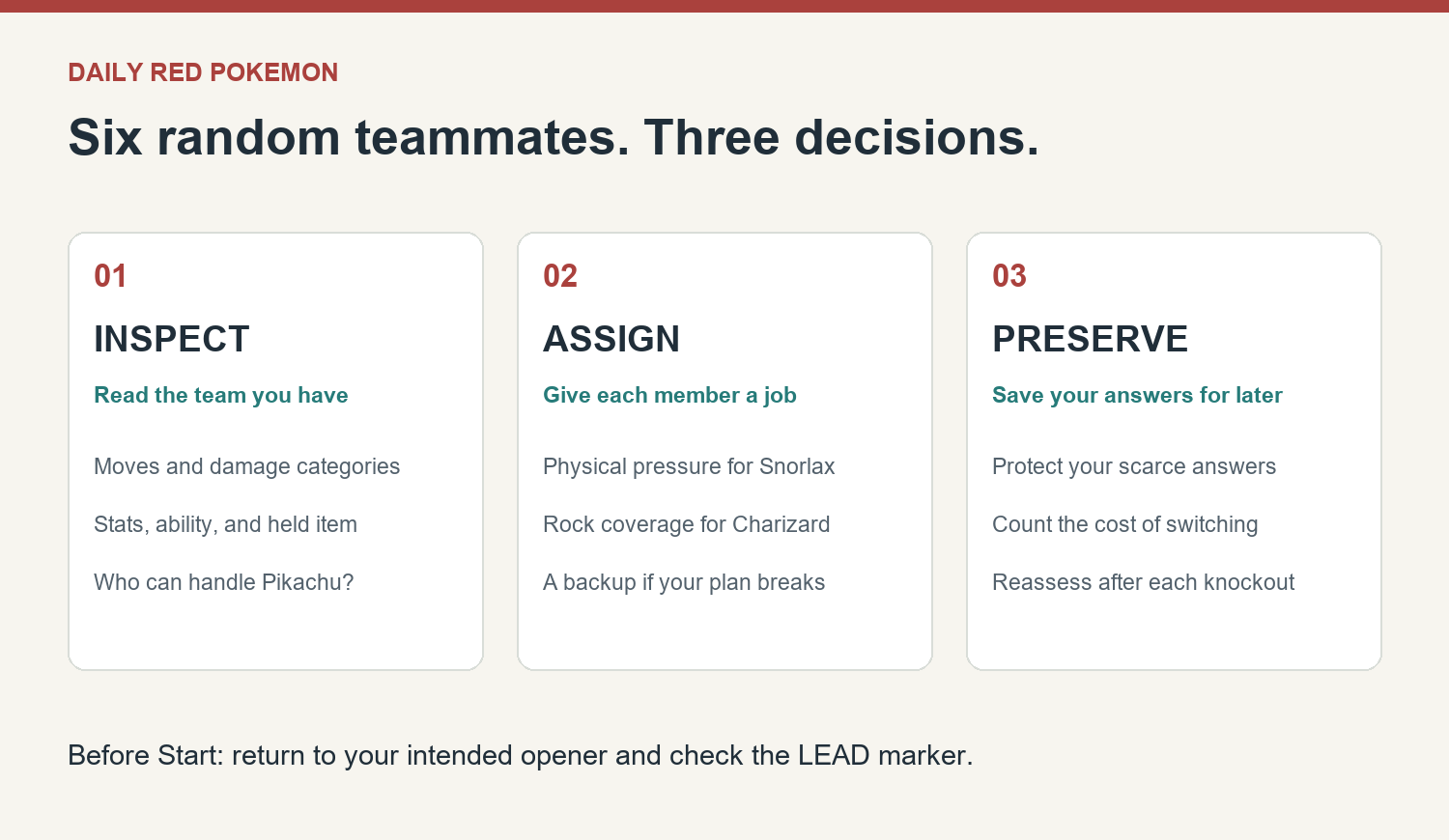
What is random in the Daily Red Pokemon game?
Your daily lineup contains six different species selected from a pool of 30 Pokémon drawn from Generations 1–3. Players on the same local date and game version receive the same six. That makes it possible to compare decisions with a friend instead of simply comparing who rolled a better team.
Red’s team stays fixed: Pikachu, Espeon, Snorlax, Venusaur, Charizard, and Blastoise. Pikachu leads, but Red can switch, so the rest are not a sequence to memorize.
Here is the distinction that matters if you arrive from a randomizer:
| Decision | Daily challenge | A separate randomizer exercise |
|---|---|---|
| Which species appear | Assigned by the daily game | Chosen through your generator settings |
| Moves, abilities, and items | Preset for the battle | Must be considered separately from a species list |
| Lead Pokémon | You choose | You can discuss a possible lead |
| Attacks and switches | You choose during battle | You can sketch possible roles |
| Rerolling | Does not replace the recorded daily challenge | Useful for creating another learning exercise |
A generator can help you learn to recognize possibilities. It cannot supply a replacement team for today’s Daily Red game. Use the game’s own team screen for the actual moves and stats you will take into battle.
Read today’s six in three passes
Open Daily challenge and look through TODAY’S SIX. Check the moves, then Stats & ability. Three short passes are more useful than reading a card and immediately deciding that Pokémon is your best attacker.
1. Find your opening answer
Pikachu’s Electric attacks make a Ground-type lead attractive when one is available. Ground attacks also hit Pikachu super effectively. However, its Iron Tail and Quick Attack give it options beyond Electric damage.
Check both sides of the exchange: what you can deal and what you can survive. A lead that wins the first matchup while losing nearly all its health may leave another important job uncovered.
Inspecting another teammate changes the selected lead. After reviewing the team, return to your intended opener and confirm the ★ LEAD marker before choosing Start daily battle.
2. Identify scarce coverage
Look for jobs that only one teammate can handle well. Perhaps you have one strong physical Fighting attack for Snorlax, or a single Rock move for Charizard. Those resources deserve special attention.
Do not assign roles from species names alone. A Pokémon’s usual reputation does not tell you which four moves this version carries. Read the card you have.
3. Choose a backup
Ask what happens if your first answer is weakened or knocked out. The backup does not have to be perfect. It may finish an opponent after earlier damage, use a priority move, or resist an attack well enough to give you another decision.
This is often the difference between a plan and a wish: a plan still has something to do after the first exchange goes badly.
Give each of Red’s Pokémon a place in your plan
Use this matchup sheet to decide what to preserve, not to predict a fixed order of opponents.
| Opponent | Useful starting point | What can upset the plan |
|---|---|---|
| Pikachu | Ground immunity and Ground damage | Iron Tail, Quick Attack, or a switch |
| Espeon | Dark, Ghost, or Bug coverage | A move whose Gen 3 category does not suit its user |
| Snorlax | Strong physical Fighting damage | High HP, Leftovers recovery, and Immunity blocking poison |
| Venusaur | Fire, Flying, Psychic, or Ice coverage | Sludge Bomb or Earthquake hitting your incoming teammate |
| Charizard | Rock damage against a fourfold weakness | Ground immunity and Rock Slide’s imperfect accuracy |
| Blastoise | Electric or Grass damage | Ice Beam, Earthquake, and Brick Break coverage |
Suppose today’s six include Flygon and Breloom. Flygon has Earthquake for Pikachu and Rock Slide for Charizard, so it may be doing two important jobs. Breloom’s physical Fighting moves give it a possible role against Snorlax.
Sending Flygon into every convenient matchup could leave it too weak to help later. Spending Breloom early could remove your most direct way to pressure Snorlax. The decision is about the work still left to do, not just the damage available now.
A backup can make those choices less restrictive. If another teammate has useful Rock coverage, Flygon may have more freedom. If Snorlax is already heavily weakened, preserving Breloom at all costs may no longer make sense.
Gen 3 rules change which attacker should use a move
The Daily Red Pokemon game uses Gen 3 battle rules. Damaging moves are physical or special according to their type, rather than the individual move classification used in later generations.
That creates a trap for returning players: Shadow Ball is physical, while Crunch is special.
| Move | Gen 3 category | Offensive stat used |
|---|---|---|
| Shadow Ball | Physical | Attack |
| Sludge Bomb | Physical | Attack |
| Thunderbolt | Special | Special Attack |
| Crunch | Special | Special Attack |
| Dragon Claw | Special | Special Attack |
Jolteon offers a concrete example. Its preset has 166 Attack and 319 Special Attack, with both Shadow Ball and Thunderbolt available. Shadow Ball can exploit Espeon’s weakness, but it draws on the lower attacking stat. Thunderbolt draws on the higher stat and receives the same-type attack bonus, although Electric damage is neutral against Espeon.
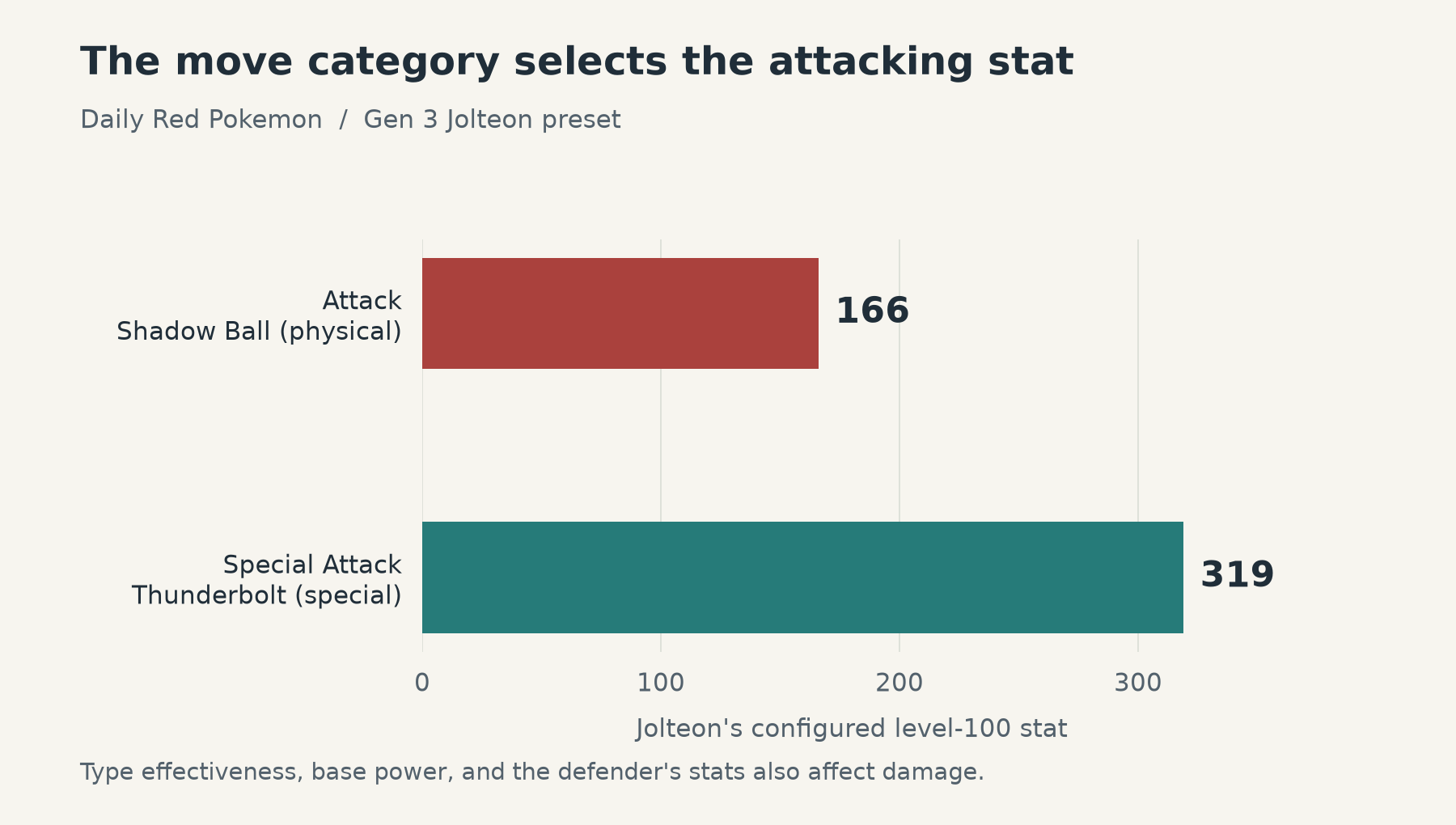
The weakness message alone does not settle which move is better. Base power, the defender’s relevant defense, and other modifiers also enter the calculation. The useful habit is to check the move’s category before trusting its matchup label.
For dailyred pokemon players, learning this one rule makes unfamiliar teams easier to read. It explains why a promising move can disappoint without assuming the battle is broken.
Use a randomizer to practice recognizing roles
The Random Pokemon Generator lets you narrow the species you explore by generation, type, forms, rarity, and base stats. Those filters work well for a short exercise between daily challenges.
Start with species from Generations 1–3 and their standard forms. Keep the type selection broad. Generate a small group and write down the roles you would investigate: a physical attacker, a special attacker, an Electric immunity, or an answer to a bulky Normal type.
Next, change one constraint. Explore a single type, or use a stat filter to look at Pokémon with stronger Attack. Notice which jobs become easier to fill and which weaknesses accumulate. The filter guide explains the available controls.
Treat this as a recognition exercise. Selecting early-generation species does not turn a general generator into a Gen 3 battle simulator, reproduce Daily Red’s 30-species pool, or give each result the game’s preset moveset.
When you return to the daily red game, repeat the role assignment using the actual team cards. That final check turns general Pokémon knowledge into a plan for this particular battle.
Switching should improve your next position
A type advantage is useful only if you can reach it without spending too much health.
A voluntary switch uses your action. If Red attacks, the incoming Pokémon normally takes that hit before it can attack on the following turn. Switching again immediately can spread damage across your whole team without making progress.
Before switching, ask:
- Can the incoming teammate take the likely attack?
- What will it be able to do on the next turn?
- Am I spending health that I need for a later opponent?
There will be turns when staying in is the better choice, even with an imperfect matchup. There will also be turns when switching saves the only teammate that can finish the battle. Compare the resulting positions instead of treating switching as automatically safe.
You can explore these choices in dailyred pokemon practice. Change one decision at a time so you can identify what improved the result.
Review one decision before trying another team
Daily Red Pokemon records one daily attempt in your browser. Starting reserves the attempt; finishing or conceding records the outcome. There are separate ways to keep learning afterward:
- Random practice gives you a separate lineup. Generate new team changes that practice team.
- Replay today’s challenge lets you try the same daily six again without replacing the recorded result.
- Watch battle replay plays back a saved battle; it does not let you choose new moves.
Find the earliest turn where your plan stopped working. Did you lose your only Fighting attacker before Snorlax appeared? Did you mistake a physical move for a special one? Did a switch cost health without giving you a useful next turn?
A missed attack or damage roll can also matter. Separate that event from the decision that exposed you to it. Sometimes the risk was necessary; sometimes a more accurate move would have been enough.
The next lineup arrives at midnight in your current time zone. Results are stored in the browser, so changing devices or clearing site data can leave you without the same history. Share the challenge date when discussing teams with friends in other time zones.
Before your next dailyred attempt, give each teammate a job and identify the one you can least afford to lose. Randomness decides which pieces you receive. Your decisions determine how much those pieces accomplish.